
4.9 STAR RATING BY 501 REVIEWS
 111 Camino Alto, Mill Valley, CA 94941
 (415) 383-2382
4.9 STAR RATING BY 501 REVIEWS
111 Camino Alto, Mill Valley, CA 94941(415) 383-2382
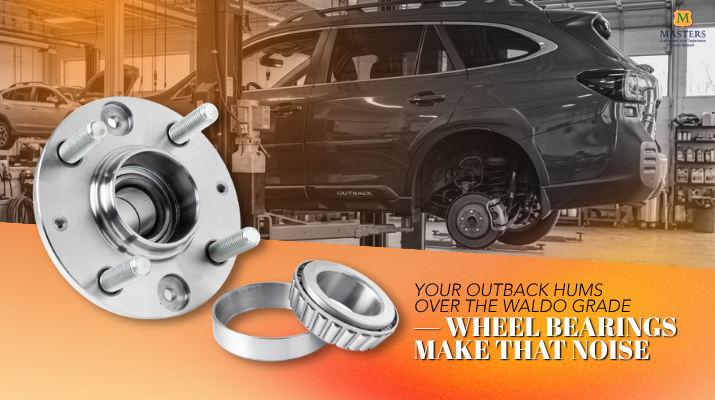
It came on so gradually you blamed the tires. Somewhere around 45 mph on the climb up the Waldo Grade there is a low hum, and it grows with speed. Then you change lanes, and the noise gets louder one way and quieter the other.
That is a wheel bearing, and it is one of the few noises a car makes that you can diagnose from the driver’s seat. On the Subaru Outbacks, Foresters and Crosstreks we service in Mill Valley, a failing hub is the single most common cause of a highway hum — and Marin‘s wet season is when a marginal one becomes a loud one.
Find an empty stretch of road at 40 to 50 mph and sway the car gently between lanes. Weight shifts to the outside wheels in a turn, so if the hum swells as you drift right the bearing is on the left, and if it swells as you drift left you should be looking at the right side of the car. The test is that reliable.
Tire noise behaves differently. It holds steady through a gentle sway, changes character on different surfaces, and often vanishes on fresh asphalt. Cupped tires hum too. So we read the tread before condemning a hub.
Speed is the other clue. A bearing hum rises and falls with road speed and pays no attention to engine rpm, so if you coast in neutral and the noise stays exactly the same, it is not coming from the drivetrain.
Modern Subaru wheel bearings are sealed cartridges, pressed into or bolted onto the hub, packed with grease at the factory and not serviceable afterward. Two rubber seals decide how long one lasts.
Water wins eventually. It slips past a hardened seal after a deep puddle or a pressure wash aimed at the wheel, emulsifies the grease, and lets rust pit the races. Then the roller path roughens and the hum starts. Quiet at first.
Some hubs also house the wheel-speed sensor ring. Let the bearing go loose enough and the sensor gap grows, the signal drops out, and the dash lights up — which makes a hum that arrives with an ABS or traction warning a strong hint about which corner to inspect first.
Autumn rain does two things to a tired hub. It gives the seal a reason to fail, and it hides the potholes that shock a bearing in the first place.
The surface does not help. ASCE’s 2025 California report card finds nearly one-third of the state’s roads in poor condition, and the patched sections of Camino Alto and Miller Avenue are typical of what a Marin commuter covers twice a day.
Then add curves. Highway 101 over the Waldo Grade and the switchbacks toward Mount Tam load first one side of the car and then the other, which is exactly the condition that makes a worn bearing sing.
A humming bearing still has life left. A grinding one does not. Once the races are badly pitted, heat builds, the bearing can seize, and in the worst case the hub flange chews the knuckle it rides in, which means buying two parts instead of one.
Play in a loose bearing also mimics other faults. It shifts camber under load, wears the tire unevenly, and can make the steering vague enough that people go hunting for tie rods.
So get the hum identified while it is still a hum. Bearings are routine work on these cars.
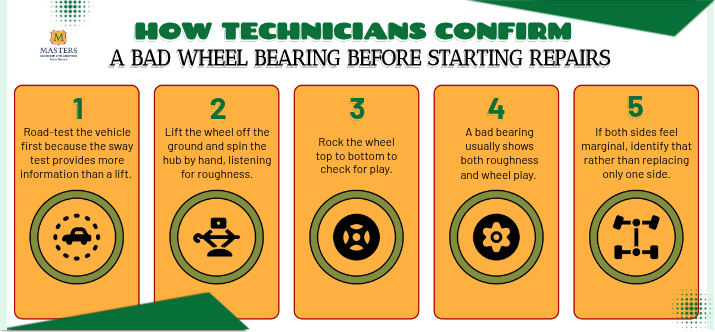
We road-test first, because the sway test tells us more than a lift does. Then, with the wheel off the ground, a technician spins the hub by hand listening for roughness and rocks the wheel top to bottom looking for play. A bad bearing usually shows both.
Where both sides feel marginal we say that, rather than replacing one and having you back in three months. This has been a family-run shop in Mill Valley since 1976, our technicians are ASE-certified across European and Japanese makes, and the work carries a 12-month/12,000-mile unconditional warranty.
Q: How do I know if it is a wheel bearing or a tire?
A: Sway the car gently between lanes at about 45 mph. A bearing noise gets louder when weight moves onto it and quieter when weight comes off; tire noise stays roughly constant and changes with road surface instead. Worn or cupped tires can hum too, so we check both.
Q: How long can you drive on a bad wheel bearing?
A: While it is humming, you have time to book the repair properly. Once it grinds, growls or wobbles, stop driving it. A seized bearing at highway speed is a genuine safety problem, and it can take the knuckle with it.
Q: Can a wheel bearing cause an ABS light on a Subaru?
A: Yes, on the hubs that carry the wheel-speed sensor. Excess play widens the gap between sensor and ring, the signal drops out, and the module sets a fault. If a hum and an ABS light arrived together, inspect the bearing on that corner first.
Q: Do wheel bearings need replacing in pairs?
A: Not usually. Bearings fail individually, so we replace the one that is bad. If the second side is already rough during inspection we will tell you, and you can decide whether to do both while the car is here.
A bearing caught while it hums is a morning’s work. A bearing caught when it grinds is a tow, a knuckle and a worse day. Drive it in, describe where you hear it, and we will run the sway test with you.
Masters European & Japanese Auto Repair – 111 Camino Alto, Mill Valley, CA 94941
Hours: Mon-Fri 8:00 AM to 5:00 PM; closed Saturday and Sunday
Website: masterseuropeanjapanese.com
