
4.9 STAR RATING BY 501 REVIEWS
 111 Camino Alto, Mill Valley, CA 94941
 (415) 383-2382
4.9 STAR RATING BY 501 REVIEWS
111 Camino Alto, Mill Valley, CA 94941(415) 383-2382

A CR-V that groans or shudders from the back during a slow, sharp turn is usually talking about its Honda CR-V rear differential fluid. For the 2002 to 2007 CR-V, Honda published a service bulletin describing that exact noise, and its repair starts with fresh fluid. Later generations add other causes. In Mill Valley the timing matters, because once the winter rain settles in, the front tires slip more often on the wet hills, and the all-wheel-drive system leans on that fluid harder than it did all summer, right before the holiday miles pile up.
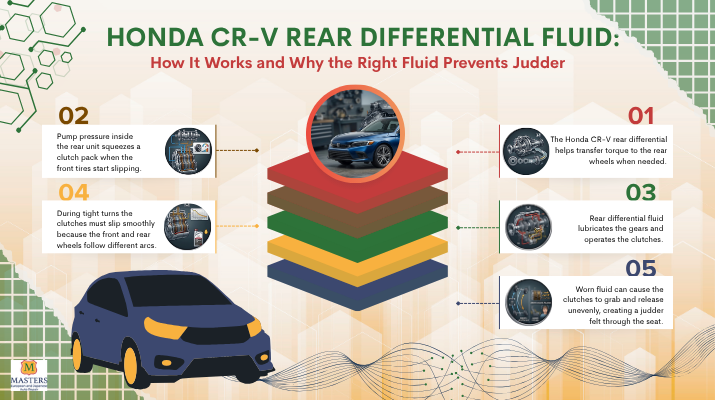
Most of the time a CR-V drives its front wheels, and the rear differential sits nearly idle until it’s needed. Honda’s bulletins call it 4WD on the early cars and Real Time AWD on later ones. When the front tires start to slip, pump pressure inside the rear unit squeezes a pack of clutches, and those clutches send torque to the back wheels.
The fluid has two jobs. It lubricates the gears, and it’s the working fluid for the clutches. In a tight turn the front wheels trace a wider arc than the rears, so the clutches have to slip smoothly against each other. Tired fluid makes them grab and let go instead. That stick-slip is the judder you feel through the seat.
Honda Service Bulletin 07-024, revised October 3, 2007, covers every 2002 to 2007 CR-V with 4WD. It describes a moan or groan from the rear differential during a sharp turn at low speed and names contaminated fluid as the probable cause. The repair is specific. Drain and refill with Honda Dual Pump System Fluid II, raise the car so all four wheels turn freely, and on an automatic hold the wheels at 10 mph in gear for five minutes, twice over. Let the unit cool for 10 minutes, then drain and fill a second time.
Each fill on a 2005 to 2007 model is 1.3 quarts. Then comes a 2-mile road test with at least 20 turns. Still groaning? Honda’s instruction is to go back up on the lift and repeat the burnishing and the second fluid change.
By the 2012 model year the CR-V’s rear differential had an electric pump motor and a pressure solenoid, so a similar complaint can have a different cause. Honda Service Bulletin 15-016, revised in August 2017, covers 2012 and 2013 CR-Vs with AWD plus 2014 cars within a set VIN range. On those, a worn pressure solenoid plunger lights the AWD indicator and stores code C1858-73. Fresh fluid won’t cure that one.
Listen to when the noise happens. Groaning only in parking-lot turns points at the differential, while a hum that climbs with road speed and changes as you shift lanes is more often a wheel bearing. Those are different repairs. Get the symptom right before anything gets drained.
Rain changes how often the rear differential engages. Pulling out of a steep, wet driveway in the hills above Mill Valley, or climbing Camino Alto on fallen leaves, the front tires break traction for a split second and the rear clutches clamp. A wet November means a lot more of those hill starts.
Tires matter as well. One replacement tire with a different diameter, or a set worn unevenly front to back, makes the axles turn at slightly different speeds all the time, so the clutches never rest. Match them.
The drain plug is where a routine service goes wrong. Honda’s November 2023 ServiceNews article A23110A says the AWD rear differential drain plug on 2018 to 2024 CR-Vs is specified at 47 N·m (35 lb-ft), and that the threads fail between 108 and 164 N·m. Impact guns strip them fast. When Honda analyzed returned rear differentials, it found many drain plug threads stripped during routine servicing.
Seals deserve a look while the car is on the lift. NHTSA’s PE22-011 investigation covered 1,506,107 all-wheel-drive CR-V and HR-V models from 2018 to 2022, in which Honda’s data showed 1,201 field reports of rear differential seizure blamed on oil lost through damaged seals, and closed in July 2024 without a manufacturer action.
Q: Why does my Honda CR-V groan when I make a tight turn?
A: On a CR-V with all-wheel drive, the usual cause is worn or contaminated rear differential fluid. The clutches inside the rear unit slip unevenly, and Honda’s own bulletin for 2002 to 2007 models calls for a fluid change and a clutch-burnishing procedure to cure it.
Q: What fluid goes in a Honda CR-V rear differential?
A: Honda’s bulletins for the 2002 to 2007 CR-V and the 2012 to 2014 CR-V both list Honda Dual Pump Fluid II, part number 08200-9007. Use what Honda specifies, not a generic gear oil off the shelf.
Q: Is it safe to keep driving a CR-V with a noisy rear differential?
A: For a short while, but don’t let it ride. The groan means the clutches are working in poor fluid, and a unit that keeps losing fluid through a bad seal or a stripped plug can fail, so have it checked soon, and sooner if you see drips under the rear axle.
Two details help. When you send the shop a message, say whether the groan comes only in tight, slow turns or on the open road too, and whether the AWD light has come on. They separate a fluid job from a bearing or a solenoid. Masters, a family-run Mill Valley shop since 1976, is at 111 Camino Alto, Mill Valley, CA 94941. Booking ahead lets the shop have Honda’s fluid ready.
