
4.9 STAR RATING BY 501 REVIEWS
 111 Camino Alto, Mill Valley, CA 94941
 (415) 383-2382
4.9 STAR RATING BY 501 REVIEWS
111 Camino Alto, Mill Valley, CA 94941(415) 383-2382

Mill Valley’s mild Marin County climate is gentle on cars day to day. Summer road trips are a different story. The moment you point the car east toward Central Valley heat, north toward the wine country grades, or up the coast on Highway 1, you ask the cooling system, A/C, tires, and brakes to perform under sustained load they never see on the daily drive.
That contrast is exactly why a pre-trip inspection matters here. Master’s European & Japanese Auto Repair at 111 Camino Alto has served Mill Valley since 1978 as a family business, and the start of road-trip season is one of the most valuable times to bring a car in.
Mill Valley’s moderate climate hides weaknesses. A cooling system slightly down on coolant, a water pump with an early seal weep, or an A/C charge that has drifted low will all perform acceptably in 65-degree Marin air on short drives. None of those conditions demands the system’s full capacity, so the marginal component never reveals itself.
A summer road trip removes that cushion. Climbing the Waldo Grade fully loaded, or descending toward the Central Valley in 95-degree heat with the A/C running, demands everything the cooling and climate systems can deliver. A pre-trip inspection finds the marginal component in the shop, where it is a planned repair, rather than on the shoulder of Highway 1. Schedule a pre-trip inspection at Master’s European & Japanese in Mill Valley.
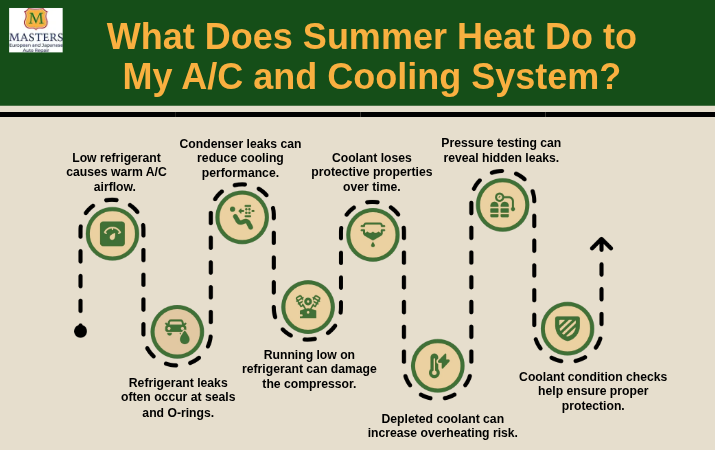
A sealed A/C system that blows warm is low on refrigerant, and a low charge means an active leak – commonly at the condenser, the compressor seal, or the line O-rings that harden with age. Before a hot drive, a warm-blowing A/C should be diagnosed and the leak repaired, not topped off with a parts-store can that masks the problem and can introduce sealer that clogs the system. The U.S. Environmental Protection Agency requires certified handling of vehicle refrigerant, and a proper recovery, leak repair, and recharge is what makes the fix last.
Engine coolant deserves equal attention. Its corrosion inhibitors and boil-over protection deplete over time, and depleted coolant that coped with Mill Valley’s mild climate can allow an engine to run hot on a long grade. A pressure test surfaces leaks invisible at ambient pressure, and a condition check confirms the additives still protect. Both are quick, inexpensive steps. Contact Master’s European & Japanese Auto Repair in Mill Valley before your trip.
Tires carry a disproportionate share of road-trip risk. Summer heat increases air pressure and operating temperature, and the U.S. National Highway Traffic Safety Administration identifies the combination of heat, under-inflation, high speed, and heavy load as a leading cause of tire failure – precisely the conditions of a fully loaded drive on Highway 1 or I-80. A pre-trip check verifies tread depth, looks for uneven wear and sidewall damage, and sets pressures for the expected load.
Brakes matter most on the grades. Marin and coastal driving means long descents – off Mount Tamalpais, down toward Stinson Beach, or returning from the Sierra – where brakes work continuously, and heat builds. Worn pads or aging fluid that has absorbed moisture can fade on a sustained descent. Checking pad thickness, rotor condition, and brake fluid moisture before the trip ensures the brakes have the margin those descents require.
A summer pre-trip inspection covers the systems, distance and heat stress most. The A/C is checked for cold output and correct pressures, with leak detection if needed. The cooling system is pressure tested, and the coolant is verified. Tires are inspected for tread, wear pattern, damage, and pressure, and the brakes are checked for pad and rotor condition and fluid moisture. Book a pre-trip inspection at Master’s European & Japanese Auto Repair in Mill Valley.
The inspection also covers the battery, belts, hoses, and fluid levels – the supporting components that summer heat degrades. With five ASE-Certified Technicians and an unconditional 12-month/12,000-mile warranty, the shop gives Marin drivers a clear, prioritized picture before they leave.

Q: How long does a pre-trip inspection take at Master’s European & Japanese in Mill Valley?
A: A thorough inspection typically takes an hour or two, depending on findings. Contact the shop at (415) 383-2382 to schedule, ideally a week or more before your trip.
Q: Does Master’s European & Japanese service Japanese and domestic vehicles too?
A: Yes – in addition to Audi, BMW, Mercedes, Volvo, Volkswagen, Jaguar, and Land Rover, the shop services Acura, Honda, Lexus, Toyota, Infiniti, Nissan, Subaru, and most domestic cars and trucks.
Q: Is summer really harder on my battery than winter?
A: Yes – heat accelerates the chemical processes that wear a battery out, and many batteries that survive winter fail in the first summer heat. A pre-trip battery test is worthwhile.
Q: Does Master’s European & Japanese serve drivers throughout Marin County?
A: Yes – the shop at 111 Camino Alto serves drivers from Sausalito, Tiburon, Corte Madera, San Rafael, Novato, and surrounding communities.
Master’s European & Japanese Auto Repair
111 Camino Alto, Mill Valley, CA 94941
Phone: (415) 383-2382
Website: masterseuropeanjapanese.com
Hours: Mon-Fri 8:00 AM – 5:00 PM
