
4.9 STAR RATING BY 501 REVIEWS
 111 Camino Alto, Mill Valley, CA 94941
 (415) 383-2382
4.9 STAR RATING BY 501 REVIEWS
111 Camino Alto, Mill Valley, CA 94941(415) 383-2382
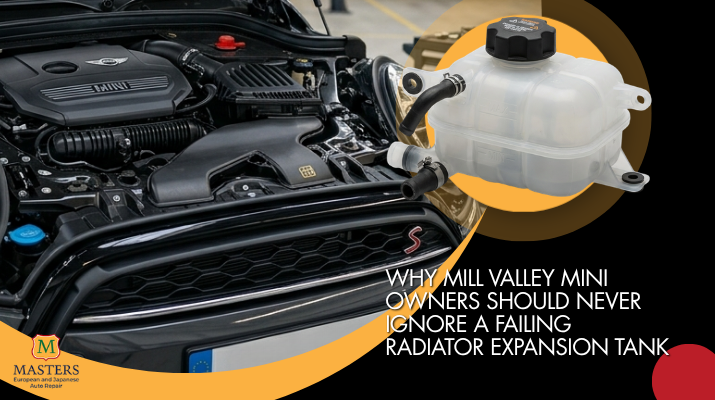
MINI Coopers have earned a devoted following in the Bay Area, and it’s easy to see why — they’re agile, fuel-efficient, and genuinely fun to drive on the winding roads around Mill Valley and Marin County. But beneath the charming exterior, first- and second-generation MINIs carry a known weak point: the plastic radiator expansion tank. This small but critical component is responsible for managing coolant pressure and overflow in your MINI’s cooling system, and when it fails — often suddenly and without much warning — the consequences can range from a frustrating breakdown to serious engine damage. At Masters European & Japanese Auto Repair in Mill Valley, we’ve seen dozens of these failures and want MINI owners to understand the risk before it catches them off guard.
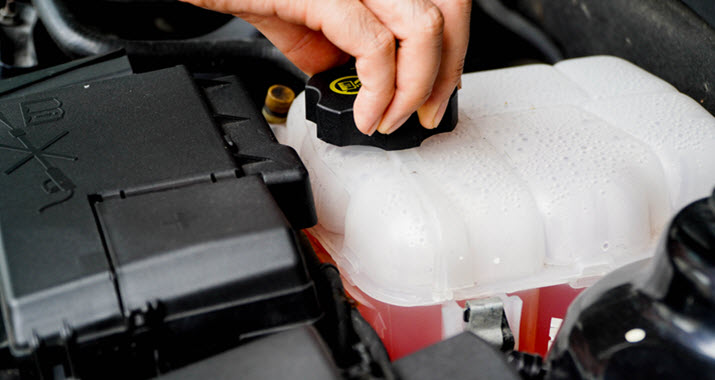
The expansion tank, sometimes called the coolant reservoir or overflow bottle, plays an active role in your MINI’s cooling system rather than just sitting passively on the side. Pressurized coolant circulates through the engine, radiator, and heater core, and as the engine heats up, coolant expands and needs somewhere to go — that’s the expansion tank’s job. It absorbs expanded coolant under pressure and returns it to the system as the engine cools. A pressure cap on the expansion tank maintains the system at the correct operating pressure, which raises the coolant’s boiling point and prevents vapor lock. On MINI Cooper models from the R50 through R56 generation, these tanks are injection-molded from plastic, which is cost-effective but degrades over time from repeated heating and cooling cycles and exposure to pressurized coolant chemistry.
Plastic expansion tanks on MINIs typically fail in one of two ways. The most dramatic is a sudden crack or split — often at a seam, fitting, or near the cap neck — that dumps coolant rapidly and can leave the engine dangerously low on coolant within minutes. This often happens when the car is already warm, and the system is at full operating pressure. The second, more insidious failure mode is a gradual seep or weep through hairline cracks, which slowly depletes the coolant level without any obvious external leak. In both cases, the plastic fatigue is accelerated by age, high Bay Area ambient temperatures, and the constant thermal cycling that comes with stop-and-go traffic on 101 and surface streets. MINI models with the turbocharged N14 and N18 engines see additional heat stress that wears the tank faster than naturally aspirated versions.
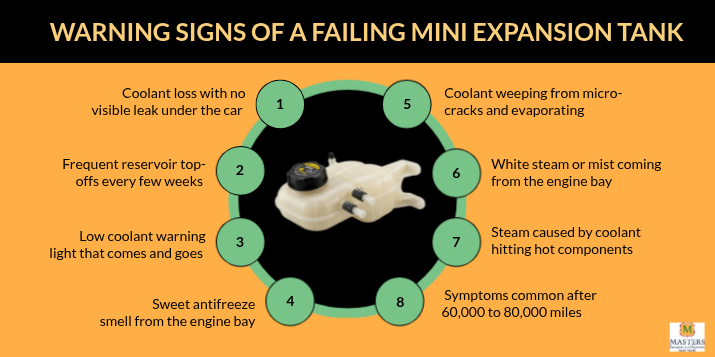
MINI drivers often get advance notice of expansion tank trouble before a complete failure. The most common early indicator is coolant loss with no visible leak under the car — if you’re topping off the reservoir every few weeks, something is wrong. A persistent low coolant warning light that illuminates and clears repeatedly is another classic sign. You might also notice a sweet antifreeze smell from the engine bay, particularly after a warm drive, as hot coolant weeps from micro-cracks and evaporates on nearby surfaces. White steam or mist from the engine bay is a more serious sign indicating active coolant contact with hot components. Any of these symptoms in a MINI with more than 60,000 to 80,000 miles warrants immediate inspection — proactive tank replacement is far less expensive than a blown head gasket caused by overheating.
At Masters European & Japanese in Mill Valley, we offer a wide range of services for your MINI, and handle MINI cooling system work regularly. Our team often recommends proactive expansion tank replacement on higher-mileage R50, R52, R53, R55, R56, and R57 models even when the tank hasn’t failed yet. The cost of a quality replacement tank is modest, and the labor is straightforward for experienced MINI technicians. We also inspect the radiator hoses, thermostat, and water pump for wear at the same time, since these components share similar service intervals and share the consequences of a cooling system failure. We use quality components that match or exceed OEM specifications and pressure-test the system after the repair to verify a complete seal.
If you drive a MINI in the Marin area and your coolant level seems inconsistent, don’t wait for a breakdown on the side of Sir Francis Drake Boulevard. At Masters European & Japanese Auto Repair in Mill Valley, our technicians are well-versed in MINI cooling system vulnerabilities and can inspect or replace your expansion tank quickly. Contact us online, call us at (415) 383-2382, or stop by 111 Camino Alto, Mill Valley, CA 94941 to schedule your appointment.
Q: At what mileage should I replace my MINI’s expansion tank proactively?
A: We typically recommend inspection at 60,000 miles and proactive replacement by 80,000–100,000 miles, or sooner if you’re seeing any coolant loss.
Q: Can I drive my MINI if the low coolant warning light comes on?
A: No — driving with low coolant risks overheating and serious engine damage. Pull over safely, let the engine cool, and have the car towed or inspected before driving further.
Q: Is the expansion tank the same as the overflow bottle?
A: On MINIs, the expansion tank is a pressurized component that actively manages coolant — it’s not a simple passive overflow bottle. This distinction matters for diagnosis and proper replacement.
Q: Why do plastic expansion tanks fail on MINIs so often?
A: The plastic composition used in these tanks becomes brittle over time from repeated heat cycling and constant exposure to pressurized coolant. It’s a known design limitation across multiple MINI generations.
